

Table of Contents
- Best No Pull Harness for Large Dogs: What Actually Works
- Front-Clip vs Back-Clip Dog Harness: Which Stops Pulling?
- How to Fit a Dog Harness for Large Breeds
- Escape-Proof Dog Harness for Large Dogs: Secure Fit and Adjustment
- Do No-Pull Harnesses Work? What the Evidence and Owners Say
- Comfort, Padding, and Freedom of Movement in Daily Use
- Durability, Materials, and Long-Term Wear and Maintenance
- Choosing the Right No Pull Harness for Your Large Dog
- Frequently Asked Questions
Last Updated: October 6, 2026
Best No Pull Harness for Large Dogs: What Actually Works
The best no pull harness for large dogs redirects forward momentum instead of fighting it. At Wonder Walker & Co., we build our harnesses around a dog's natural push-and-pull reflex: when a 70-pound lab hits the end of the leash, the harness turns that energy sideways rather than backward, gentler on the dog's neck and shoulders and easier on your arm.
A harness only controls pulling if it fits correctly and sits on the right part of the chest.
What to Look For in a Large-Dog Harness
Five features decide whether a harness holds up on a strong, high-energy dog:
- Front leash attachment point that turns the dog toward you when they pull
- Adjustable straps at both the chest and the girth, not just one
- Wide, padded chest plate that spreads pressure across the sternum
Weight distribution matters more with large breeds. A harness that concentrates force on a narrow strap can rub shoulders raw on a long walk. The American Kennel Club's guidance on harness types notes that fit and padding are the difference between a harness a dog tolerates and one they're comfortable in for hours.
| Feature | Why It Matters | What to Avoid |
|---|---|---|
| Front clip | Redirects pulling sideways | Clip sewn to thin webbing |
| Dual adjustment | Custom fit for deep chests | Single-strap sizing |
| Padded chest plate | Prevents chafing | Bare nylon against skin |
| Metal hardware | Holds under sudden load | Brittle plastic buckles |
| Reflective threading | Night visibility | No visibility features |
Front-Clip vs Back-Clip Dog Harness: Which Stops Pulling?
A front-clip harness stops pulling better than a back-clip harness because the leash attachment sits on the dog's chest. When the dog surges forward, the front clip steers them sideways, breaking the straight-line pull. A back clip sits between the shoulders and can reward pulling.
Back clips aren't useless: for a calm dog or a senior who walks politely, a back clip is fine.
- Pulling hard on every walk: front clip
- Occasional tugging, mostly relaxed: back clip works
- Training a young large breed: front clip from day one
Dual Attachment Points and Double-Ended Leash Setups
Dual attachment points give you a front clip and a back clip on the same harness, and a double-ended leash connects to both, the setup we recommend for strong dogs and crowded sidewalks. The back clip keeps the dog from bolting; the front clip provides steering. On a busy street, clip to both and hold the front handle short; on an open trail, use the back attachment alone.
How to Fit a Dog Harness for Large Breeds
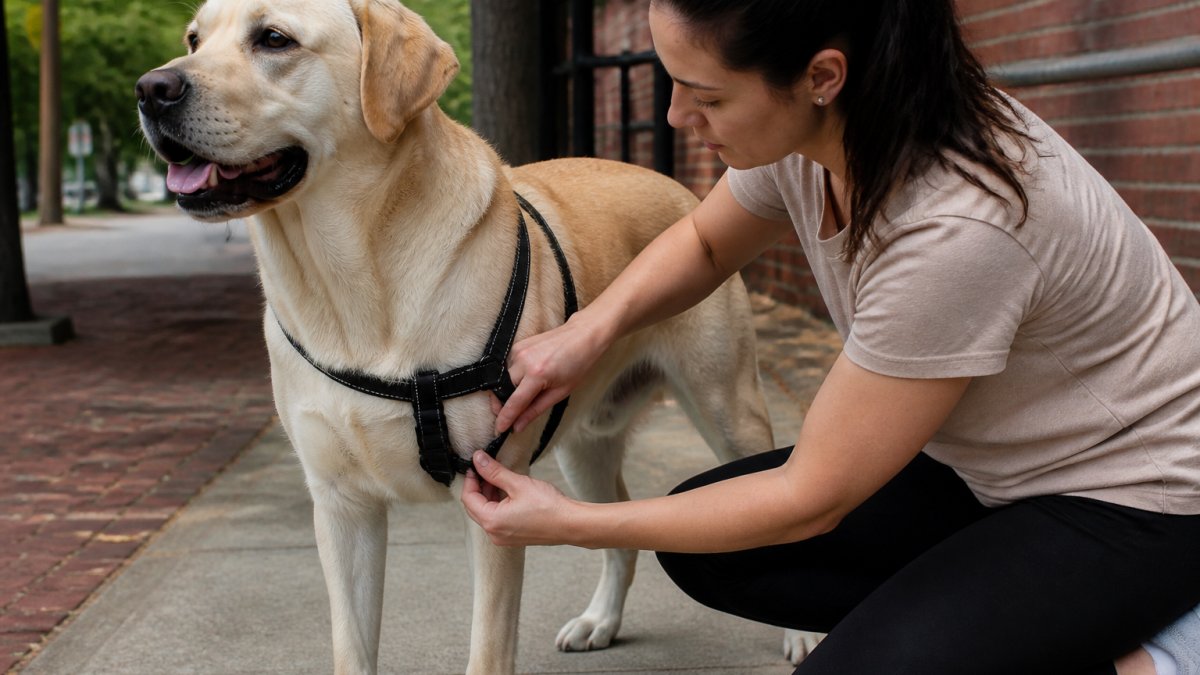
A correctly fitted large-dog harness sits snug with room for two fingers under any strap, and never slides toward the throat when the dog pulls.
Why Body Shape Matters More Than Weight
Weight tells you how strong the dog is; body shape tells you where the harness will sit. Three measurements matter:
- Chest girth at the deepest point of the ribcage, just behind the front legs. This is the primary sizing number, but pair it with the next two.
- Neck circumference at the base, where the collar band rests. A thick-necked breed like a Mastiff may need a longer neck strap to avoid choking pressure.
- Shoulder width across the widest part of the shoulder blades. Narrow-shouldered deep-chested dogs (e.g., Greyhounds, Salukis) often slip out of harnesses sized only by girth because the straps cannot cinch tight enough without restricting movement.
A common pattern: a dog measures "large" by girth but has a narrow waist and deep chest, so the girth strap sits too low and the chest plate rides up toward the throat. The fix is independent adjustment at the neck, chest, and girth.
Step-by-Step Fit Protocol for Strong Dogs
- Measure at the deepest ribcage point, not the widest part of the chest, often several inches behind the front legs on deep-chested breeds.
- Measure the neck base with the dog standing, not sitting, which compresses the neck and gives a false reading.
- Compare both numbers to the brand's size chart. If chest girth falls in size L and neck in size M, choose the size that accommodates the larger measurement and adjust down.
- Adjust the girth strap first, then the chest, then the neck. The girth should be snug, two fingers maximum, and sit behind the shoulder blades, not across them.
- Check shoulder clearance: lift each front leg forward as if taking a step. The harness should not pull across the shoulder joint or restrict reach.
- Recheck after three walks. Webbing stretches and a hard puller shifts straps; tighten the girth one notch if the harness rotates.
Sizing Across Brands: Why a Large Is Not Always a Large
Sizing is not standardized: one brand's large may fit a 60-pound dog; another's may start at 80 pounds. Measure your dog and compare against that brand's chart. If your dog falls between sizes, size up and tighten the straps, slightly too large can be adjusted down, too small cannot be stretched. For deep-chested breeds, a longer chest panel sits lower and stays put; for broad-shouldered breeds, look for wider strap spacing at the front.
When a Harness May Not Fit
Some body shapes are genuinely hard to fit with a standard harness. Dogs with very narrow shoulders and a deep chest may need a custom or sighthound-specific harness. Dogs with very short backs (e.g., some bulldog breeds) may find a long chest panel interferes with leg movement. If you cannot achieve a snug fit without restricting movement, the design is wrong for that dog.
Escape-Proof Dog Harness for Large Dogs: Secure Fit and Adjustment
An escape-proof dog harness for large dogs has at least three adjustment points and a chest plate that sits low enough to prevent backing out. Escape is not random: dogs plant their feet, pull backward, and use the opposition reflex to slip the straps over their shoulders.
How Dogs Escape: The Backing-Out Sequence
When a dog backs up against a taut leash, the girth strap slides toward the neck and the chest plate rides up toward the throat. If the neck opening is large enough, the dog's shoulders pop through and the harness falls away. A 90-pound Labrador can back out of a harness that fits a 40-pound dog perfectly.
The Three-Point Adjustment Rule
A harness is only escape-resistant with independent adjustment at three locations:
- Neck strap: controls the opening the dog could slip through. It must be snug, no more than two fingers, and sit at the base of the neck, not near the ears.
- Chest strap: runs horizontally across the chest, keeping the harness centered and preventing rotation.
- Girth strap: wraps behind the ribcage. This is the primary anchor. It must be tight enough that the harness cannot slide forward when the dog backs up.
If any one is loose, the dog has an escape route. The most common mistake is leaving the neck strap too loose because it seems comfortable.
Pre-Walk Escape Check
Run this check before every walk, especially with a dog that has escaped before:
- Girth strap snug, two fingers of room maximum
- Neck strap snug, two fingers maximum, sitting at the base of the neck
- Chest plate centered, not shifted to one side
If the harness slides forward when you pull back, the girth is too loose. Tighten it by one notch and recheck.
Fit Checks for Strong Dogs
Beyond the basic checklist, test these scenarios:
- The back-up test: Apply gentle backward pressure on the leash. If the harness shifts forward, the girth is too loose or the chest plate too short.
- The shoulder test: Lift one front leg forward as if stepping. If the harness pulls across the shoulder or restricts movement, the neck strap is too tight or the chest panel too long.
- The twist test: Try to rotate the harness side to side. If it twists easily, the chest strap is too loose.
When to Consider a Different Design
Some dogs are genuine escape artists. If your large breed has escaped multiple harnesses, the issue may be design, not fit. Look for a martingale-style loop that tightens slightly when the dog pulls backward, a belly strap connecting the girth to the chest plate, or a double-girth design anchoring at two points behind the ribcage. These add security but also complexity, worth it if the harness stays on during a moment of panic.
Do No-Pull Harnesses Work? What the Evidence and Owners Say
No-pull harnesses work when fitted correctly and used consistently: a front-clip design turns the dog's forward pull into a sideways arc, far easier to manage than a straight drag. Our own no-pull harness holds a 4.8/5 rating across 5,209 reviews, and customers like Rhonda-Lee Krone have shared how it changed daily walks with a strong dog. A common mistake is expecting instant results, pulling is a habit, and a harness changes the physics of the walk, not the dog's motivation overnight.
Comfort, Padding, and Freedom of Movement in Daily Use
Comfort decides whether a dog wears a harness willingly, and freedom of movement decides whether it's good for their body. A well-designed large-dog harness leaves the shoulders clear so the front legs extend fully; harnesses crossing directly over the shoulder joint can restrict a dog's gait, especially at a trot or run. Look for padding at the chest plate and under the front legs, where friction builds up, wide, soft panels spread pressure better than narrow straps.
- Padded chest plate reduces chafing on deep-chested breeds
- Clear shoulder room supports a full stride
- Soft, wide straps distribute pressure
Durability, Materials, and Long-Term Wear and Maintenance
Durability comes down to webbing quality, hardware strength, and stitching. A large dog generates serious force at the end of a leash, so the weakest link fails first: cheap plastic buckles crack, thin webbing frays, weak stitching pulls apart.
To make a harness last:
- Rinse off mud and salt after wet or winter walks
- Check the front clip webbing monthly for fraying
- Hand wash in mild soap, air dry, never machine dry
Reflective threading is worth prioritizing for night walks: it doesn't replace a light, but it makes your dog visible to drivers.
Choosing the Right No Pull Harness for Your Large Dog
Match the harness to your dog's behavior and walking routine, not the flashiest listing. A strong puller on city sidewalks needs a front clip, dual attachment points, and reflective threading; a calmer large breed may do fine with a simpler back-clip design.
At Wonder Walker & Co., we designed our harness to use a dog's push-and-pull reflex to redirect pulling behavior, relieve neck pressure, and support natural movement. It's customizable with colored back straps and built with reflective threading for nighttime safety.
Frequently Asked Questions
What is the best anti-pull harness for large dogs?
The best option for a large dog combines a front-clip leash attachment point, a padded chest plate, and adjustable straps that hold a secure fit without restricting the shoulders. Look for a harness that redirects forward motion sideways rather than tightening across the throat. A dual attachment point helps too, so you can clip to the chest for training walks and the back for relaxed ones. Fit matters as much as design: a harness that shifts or gaps will not control a strong dog.
Is a front-clip or back-clip harness better for a large dog that pulls?
For pulling, a front-clip harness is usually the better starting point. When your dog surges forward, the leash pressure turns them gently back toward you, which interrupts the pull instead of feeding it. A back-clip harness gives a strong dog more leverage to lean into the leash. Many owners end up using both: front clip for training and crowded walks, back clip for sniff-heavy or relaxed strolls. A harness with dual attachment points lets you switch without buying twice.
Do no-pull harnesses actually work?
They work as a management and training aid, not a magic fix. A no-pull harness changes how leash pressure reaches your dog, which makes pulling less rewarding and gives you more control in the moment. That said, the harness does the steering while you do the training. Pair it with reward-based walking practice, and most owners notice calmer walks within a few weeks. Without any training, a determined dog can still lean into the gear.
Can a no-pull harness hurt a dog?
A correctly fitted no-pull harness should not hurt your dog. Problems usually come from poor fit or the wrong design: a chest strap that sits too low can rub the armpits, and a tightening style that cinches the chest can restrict breathing during hard pulls. Check for chafing behind the front legs after the first few walks, and watch your dog's gait for shortened strides. A padded, properly adjusted harness that leaves the shoulders free to move is the safest choice for large breeds.
Walking a strong dog shouldn't feel like a tug-of-war, and it doesn't have to. Wonder Walker & Co. builds harnesses and multi-functional leashes that redirect pulling, protect your dog's neck, and keep both of you moving comfortably. Explore the no-pull harness and double swivel leash, then get started with Wonder Walker & Co. and enjoy calmer, easier walks together.